
In the semiconductor industry, precision is everything. As devices become smaller and more complex, the components that enable their functionality must meet exacting standards for dimensional accuracy, surface finish, and material properties. While 3D printing has gained popularity for rapid prototyping and low-volume production, electroforming offers distinct advantages when it comes to producing high-precision components for semiconductor applications.
key benefits of electroforming over 3D printing
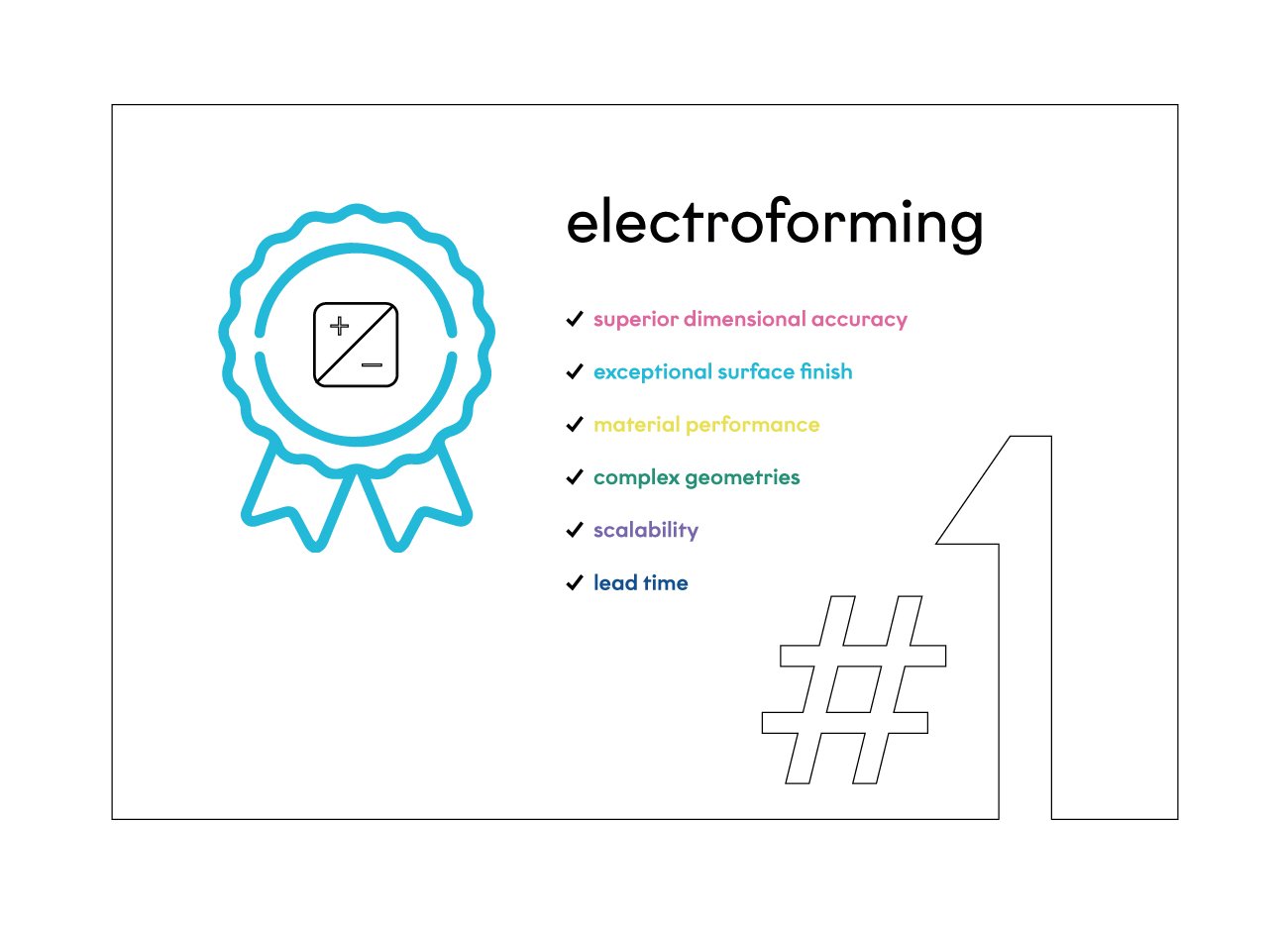
1. superior dimensional accuracy
Electroforming can achieve tolerances in the micron range,far surpassing most 3D printing technologies. For semiconductor components—such as masks, microfluidic channels, and precision apertures—this level of accuracy is critical to ensure performance and reliability.
2. exceptional surface finish
Unlike 3D-printed parts, which often require extensive post-processing to achieve smooth surfaces, electroformed components naturally exhibit excellent surface finishes. This reduces the need for secondary operations and ensures optimal functionality in applications where surfacequality impacts performance, such as optical components.
3. material purity and performance
Electroforming produces solid components from pure metals like nickel, copper, or gold, offering superior conductivity, corrosion resistance, and thermal stability. In contrast, many 3D printing processes rely on composite or poweder-based materials, which rarely meet the stringent requirements of semiconductor environments due to, for example, porosity and abrasion sensitivity.
4. complex geometries with high repeatability
Electroforming excels at creating intricate, thin-walled structures and fine features without compromising strength or precision. While 3D printing can produce complex shapes, achieving consistent quality at micro-scale dimensions remains challenging.
5. scalability for high-volume production
Although 3D printing is ideal for prototyping, scaling up for mass production can be costly and time-consuming. Electroforming, on the other hand, offers a repeatable process that can efficiently produce large quantities of identical components with high repeatability.
6. lead time
3D Printing of metal parts is still in its infancy. The technique involves printing with minuscule metal powdered parts which are then heated (sintered) in order to suture. In addition to the time-consuming sintering process, the printed layers also need to dry so that they don’t sag. These two steps both take a considerable amount of time, which makes 3D Printing a relatively slow procedure for fabricating metal parts. Additionally, 3D Printing can only deal with one part a time. Electroforming, on the other hand, is much faster a process, during which you can grow a large number of parts simultaneously.
applications in semiconductor manufacturing
Electroforming is widely used for:
-
- Microfluidic components for wafer-level packaging
- Precision apertures and filters for optical systems
- High-purity metal parts for vacuum environments