
Sometimes, in order to achieve the very specific designs required, it is necessary to bring together more than one manufacturing technology. One aspect of our integrated technologies solution is combining our core process of electroforming with chemical etching:
High Precision and Complexity: Chemical etching allows for precise control over material removal, while electroforming enables accurate metal deposition. This combination allows for the creation of highly detailed and complex designs
Cost Efficiency: Both processes are highly repeatable and can be scaled up for mass production, resulting in significant cost savings compared to traditional manufacturing methods
Design Flexibility: The ability to create complex shapes and designs in a single step from a single supplier reduces production time and increases overall efficiency
Material Integrity: Chemical etching does not introduce thermal or mechanical stress into the material, preserving the integrity of the components
Versatility: This combination is suitable for various applications, including aerospace, electronics and automotive industries
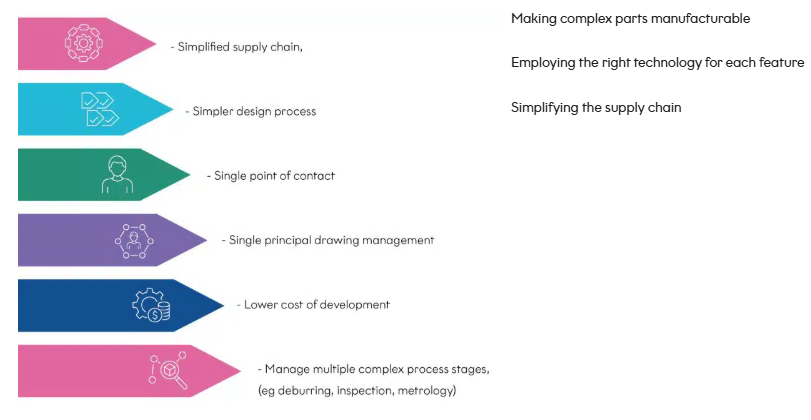
combining technologies under a single point of contact
The combination of our micro precision technologies leverages the strengths of both methods, resulting in enhanced precision, efficiency, and versatility. This powerful synergy is transforming manufacturing processes, enabling the production of high-quality, intricate components across various industries. We can also leverage plating services where necessary to offset the use of nickel in electroformed parts.
- Extreme Precision & Complexity
Can achieve very fine features and tolerances down to 1 micron, ideal for intricate cooling channels or microstructures. - Excellent Surface Finish
Smooth surfaces reduce turbulence in liquid cooling systems, improving thermal efficiency. - Material Versatility
Works well with copper, nickel and nickel alloys, which have high thermal conductivity and corrosion resistance—perfect for datacenter environments. - High Aspect Ratio Capability
Can produce components with deep cavities and thin walls without distortion, cost efficiency due to parallel production - Scalability for Thin Structures
Ideal for lightweight yet strong parts, reducing overall system weight and improving energy efficiency.
applications
Combining technologies is particularly beneficial for producing intricate and precise metal components. The integration of the two micro precision technologies allows for high accuracy, design flexibility, and cost efficiency, making it suitable for various high-tech applications.
Here are just some of the industries that use the processes in combination:
- Electronics: Used for manufacturing intricate electronic components and connectors.
- Aerospace: Produces lightweight, high-precision parts such as sensors and shielding components.
- Automotive: Creates complex parts like filters, screens, and EMI shielding for all vehicle types.
- Medical: Manufactures small, intricate components, filters and mesh for medical devices and wearable sensors.
- Defence: Produces parts for unmanned aerial vehicles (UAVs) and other advanced technologies.
- Clean energy: manufacture high-efficiency fuel cell components, such as bipolar fuel cell plates
- Analytical equipment: create precision microfluidic devices used in analytical equipment for accurate fluid control and analysis
- Semiconductor: produce intricate photomasks used in the photolithography process to pattern semiconductor wafers
stronger together - integrated micro precision technologies
%20FINAL.jpg?width=238&height=400&name=IDEX%20Group%20Diagram%20v2-01%20(002)%20FINAL.jpg) Part of IDEX Materials Science Solutions group, Veco and our sister company, Tecan bring together pioneering micro precision technologies – from electroforming to chemical etching to laser machining and beyond. Where appropriate, we can leverage these technologies to help manufacturers overcome specific and complex design challenges to achieve remarkable levels of detail and quality in the production of components, ensuring optimal performance and functionality.
Part of IDEX Materials Science Solutions group, Veco and our sister company, Tecan bring together pioneering micro precision technologies – from electroforming to chemical etching to laser machining and beyond. Where appropriate, we can leverage these technologies to help manufacturers overcome specific and complex design challenges to achieve remarkable levels of detail and quality in the production of components, ensuring optimal performance and functionality.
This approach not only enhances the capabilities of core processes but also opens up new possibilities for creating intricate and high-performance components. The combination of these technologies paves the way for innovative solutions in manufacturing, offering increased precision and efficiency in producing mission-critical parts for a wide range of industries.